
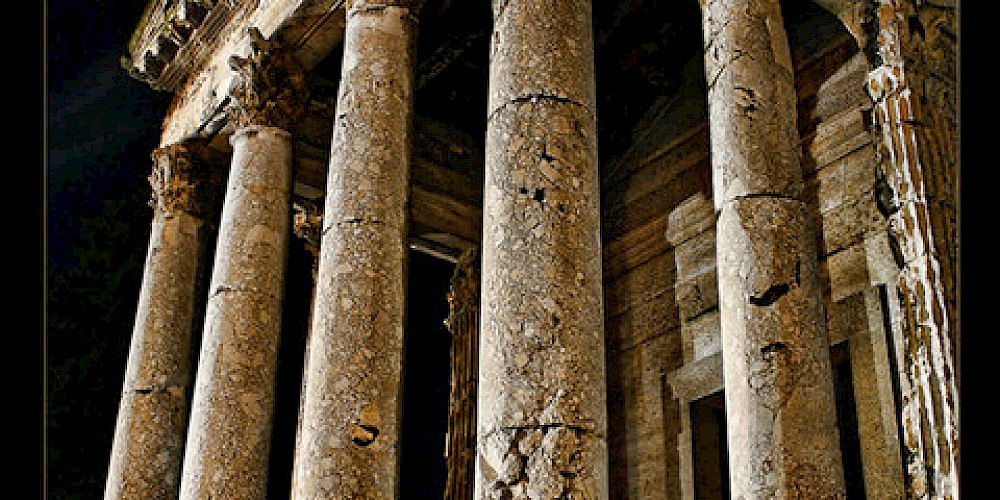
Temple of Augustus
The Temple of Augustus is the only one fully preserved, while only the back wall of the other one is visible. Said wall was used during the construction of the Town Hall. The second temple identical to the preserved Augustus and built in the same style is called the Temple of Diana. The temple, originally dedicated to the goddess Roma and Emperor Augustus, is a typical temple structure erected between years 2 BC and 14 AD. A simple square edifice consists of a cella, a closed room and an antechamber facing the square, bordered by four columns from the front and the one from its lateral sides. Columns are made from marble with Corinthian capitals. Above the columns and the cella walls is a three-part architrave with a lavishly decorated central part of the wreath above it. On its front side facing the square, the architrave reads ROMAE ET AVGUSTO CAESARI DIVI FILIO PATRI PATRIAE (to Romans and Augustus, the son of divine Caesar, the father of the homeland), used for dating the temple. Above it is a triangle gable with a round medallion. The Temple of Augustus is a wonderful example of the Roman building during the early ages of the Empire. Its decoration reflects the Late Hellenistic influence. The Temple of Augustus is the only one fully preserved, while only the back wall of the other one is visible. Said wall was used during the construction of the Town Hall. The second temple identical to the preserved Augustus and built in the same style is called the Temple of Diana. The temple, originally dedicated to the goddess Roma and Emperor Augustus, is a typical temple structure erected between years 2 BC and 14 AD. A simple square edifice consists of a cella, a closed room and an antechamber facing the square, bordered by four columns from the front and the one from its lateral sides. Columns are made from marble with Corinthian capitals. Above the columns and the cella walls is a three-part architrave with a lavishly decorated central part of the wreath above it. On its front side facing the square, the architrave reads ROMAE ET AVGUSTO CAESARI DIVI FILIO PATRI PATRIAE (to Romans and Augustus, the son of divine Caesar, the father of the homeland), used for dating the temple. Above it is a triangle gable with a round medallion. The Temple of Augustus is a wonderful example of the Roman building during the early ages of the Empire. Its decoration reflects the Late Hellenistic influence.